

astronaut: Someone trained to travel into space for research and exploration.
atmosphere: The envelope of gases surrounding Earth, another planet or a moon.
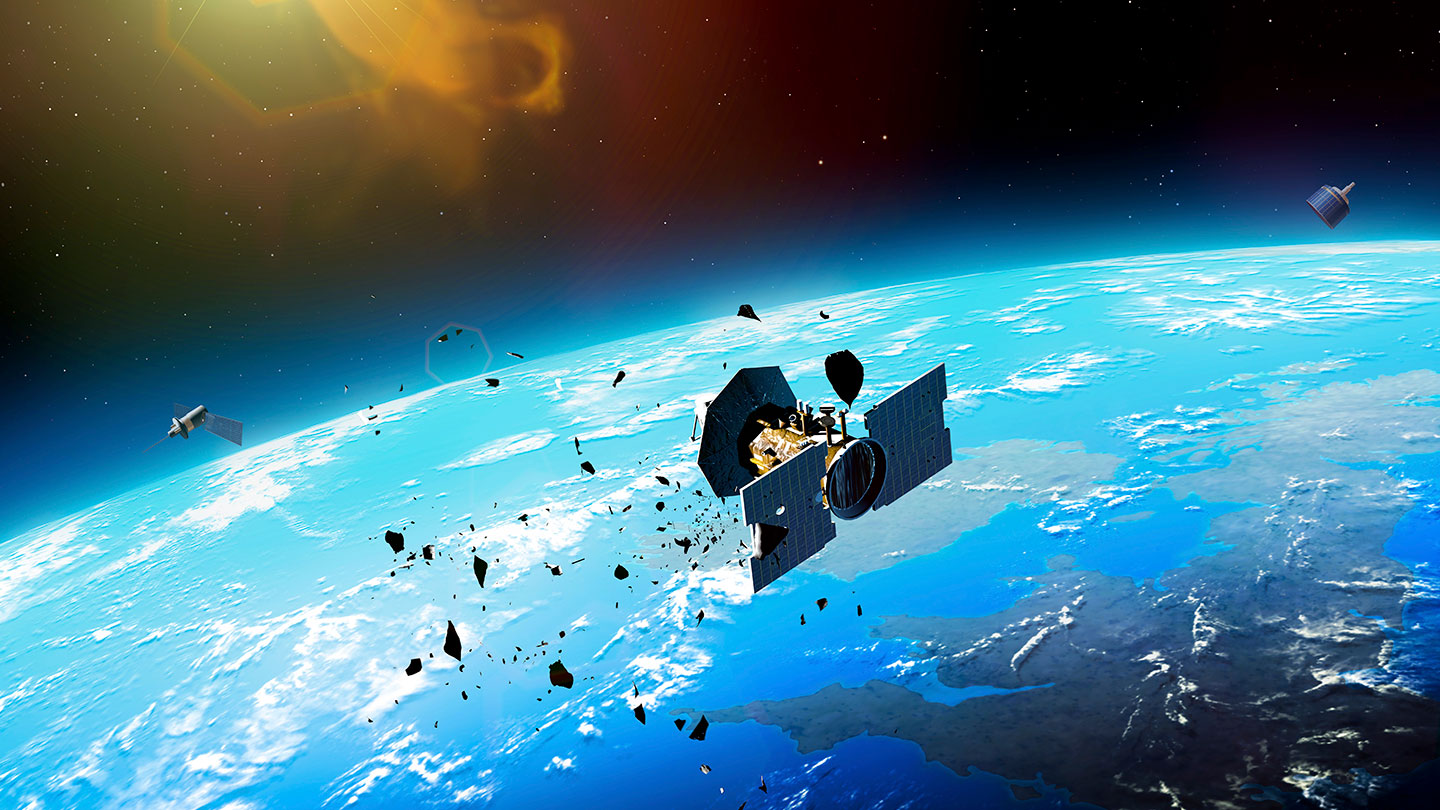
debris: Scattered fragments, typically of trash or of something that has been destroyed. Space debris, for instance, includes the wreckage of defunct satellites and spacecraft.
International Space Station: An artificial satellite that orbits Earth. Run by the United States and Russia, this station provides a research laboratory from which scientists can conduct experiments in biology, physics and astronomy — and make observations of Earth.
NASA: Short for the National Aeronautics and Space Administration. Created in 1958, this U.S. agency has become a leader in space research and in stimulating public interest in space exploration. It was through NASA that the United States sent people into orbit and ultimately to the moon. It also has sent research craft to study planets and other celestial objects in our solar system.
orbit: The curved path of a celestial object or spacecraft around a galaxy, star, planet or moon. One complete circuit around a celestial body.
rocket: Something propelled into the air or through space, sometimes as a weapon of war. A rocket usually is lofted by the release of exhaust gases as some fuel burns. (v.) Something that flings into space at high speed as if fueled by combustion.
satellite: A moon orbiting a planet or a vehicle or other manufactured object that orbits some celestial body in space.
Siberia: A region in northern Asia, almost all of which falls within Russia. This land takes its name from the language of the Tatar people, where Siber means sleeping land. This region is vast. It has become famous for its long, harsh winters, where temperatures can fall to −68° Celsius (−90° Fahrenheit).
tool: An object that a person or other animal makes or obtains and then uses to carry out some purpose such as reaching food, defending itself or grooming.
weather: Conditions in the atmosphere at a localized place and a particular time. It is usually described in terms of particular features, such as air pressure, humidity, moisture, any precipitation (rain, snow or ice), temperature and wind speed. Weather constitutes the actual conditions that occur at any time and place. It’s different from climate, which is a description of the conditions that tend to occur in some general region during a particular month or season.